Types of commercial equipment

- / Blog
- / Types of commercial equipment
The rational placement of retail equipment will help to make effective use of store space, organize sales and technological processes, and ensure customer comfort. The level of service and profit of a business depends on the choice of equipment. In this article, we will take a closer look at the types of retail equipment for stores, their purpose, and requirements.
Classification of retail equipment
The types of equipment in a retail space vary in terms of functionality, size, construction, and design. They are designed to display, store, and sell goods, as well as to create a comfortable environment for customers and staff. Below are the main categories and characteristics of different types of retail equipment.
Shelving
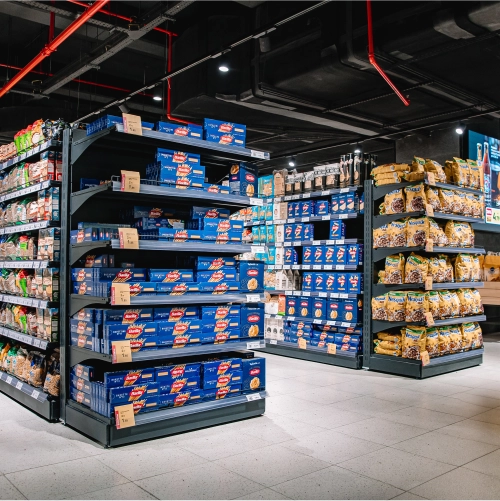
Shelving is a universal solution for displaying and storing goods. It varies in purpose and design. By purpose, it is divided into:
- Bread – with sloping shelves for convenient display of baked goods.
- For alcohol – with reinforced strength for heavy bottles.
- For fruit and vegetables – with baskets or boxes to protect the goods.
- Media – with shelves of different heights for books and magazines.
- Promotional – for promotional goods, often with a bright design.
There are three types of shelving based on their design:
- Wall-mounted shelving – installed along walls to save space.
- Island shelving – placed in the center of the room, suitable for double-sided display.
- End shelving – used at the ends of rows for accent displays.


Display cases
Display cases are designed to showcase products with an emphasis on aesthetics and accessibility. Display cases are divided into several types according to the following criteria:
- Open/closed. Open display cases are suitable for self-service, while closed ones protect products from damage.
- Wall-mounted/island. Wall-mounted display cases save space, while island display cases attract attention from different sides.
- Vertical/horizontal. Vertical display cases are convenient for narrow spaces, while horizontal ones are suitable for a wide range of products.
- Tabletop/floor-standing. Tabletop display cases are compact, while floor-standing ones can hold more products.
Display cases provide a balance between functionality and visual appeal, emphasizing the uniqueness of the product.
Refrigeration equipment
Refrigeration equipment is necessary for storing perishable products. The following types of equipment are available:
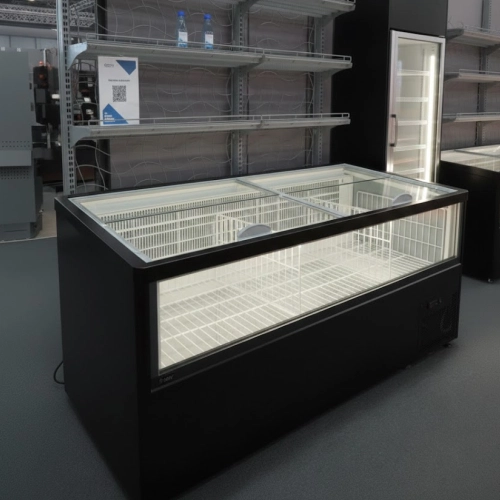
- Refrigerated showcases – for meat, dairy products, delicatessen products. They provide visibility and cooling.
- Freezer chests – for frozen products (meat or semi-finished products).
- Refrigerated display racks – for beverages, fruits, and vegetables. Convenient for self-service.
- Freezers – for long-term storage of large quantities of goods.
Refrigeration equipment maintains a stable temperature, preserving the freshness of goods.
Equipment for the checkout area
Checkout and checkout area – key elements of the retail process. The following are used in the checkout area:
- Checkout counters – include a counter, a conveyor belt for goods, and a place for the cashier. They provide ergonomics for staff.
- Self-service checkouts – automated systems to speed up payments.
- Checkout lines – for stores with high traffic where several checkouts are required.
These solutions increase service speed and convenience for shoppers.


Lighting equipment
Lighting affects the perception of goods and the atmosphere of the store. Types of lighting equipment:
- Linear – uniform lighting for general areas.
- Accent lighting – highlights specific products or areas (e.g., promotional shelving).
- Position lighting – directional lighting for display cases or counters.
Different color temperatures emphasize the characteristics of the product range – warm light for baked goods, cool light for seafood.
Requirements for retail equipment
When choosing equipment for a store, several factors must be taken into account:
- Suitability for the type of product. The equipment must be suitable for the specific product. For example, refrigerated showcases are for dairy products, and shelving with baskets are for vegetables.
- Sanitary and hygienic standards. The equipment must be safe, easy to clean, and comply with food storage standards.
- Design and space optimization. The aesthetics of the equipment should match the interior of the store, and a modular design helps to adapt it to the size of the room.
- Product protection. Durability and construction should prevent damage to the product.
- Ergonomics. Convenience for staff and customers speeds up processes and increases comfort.
- Additional accessories. Shelves, hooks, price holders, and other accessories increase the functionality of the equipment.
It remains to add that understanding the classification of retail equipment and the requirements for it helps to choose the optimal solutions for a particular store. Properly selected equipment improves storage and display of the product range, as well as increases customer loyalty, thereby increasing profits.
Contact us to learn more about commercial equipment from 4RM Systems:




Need some advice?
Send a request and we will call you back.
